

You’re reading a book, an article, or perhaps a message from someone you care about.
You finish a paragraph, turn the page, and suddenly realize something.
You have almost no idea what you just read.
So you go back. You read the same words again. This time, they seem familiar, but you’re still not sure how much you’ll remember.
If this happens to you, especially after 50, you might wonder whether your memory is changing.
But there’s another possibility worth considering.
Sometimes, the difficulty isn’t simply remembering information. It’s giving that information enough attention in the first place.
Let’s explore why this can happen and three gentle ways to make reading feel a little easier.
Why Reading and Remembering Aren’t the Same Thing
When you read, your brain does more than recognize individual words.
It follows sentences, connects ideas, and gradually builds meaning.
For that to happen, your attention needs to stay with the material long enough for you to understand it.
But imagine reading while you’re worried about tomorrow’s appointment.
Your eyes move across the page. You recognize the words. Yet somewhere in the background, you’re rehearsing what you need to say to your doctor.
By the end of the paragraph, very little of its meaning has stayed with you.
This experience is related to something researchers call mind wandering.
What Is Mind Wandering?
Mind wandering happens when your attention moves away from what you’re doing and toward other thoughts.
You might be reading a book while mentally planning dinner, remembering a conversation, or worrying about someone you love.
Research has linked mind wandering during reading with poorer comprehension.
And that distinction matters.
Not remembering what you’ve just read doesn’t necessarily mean that your memory is failing.
Sometimes, your attention simply wasn’t fully available.
The Small Desk Inside Your Mind
Another useful idea is working memory.
Think of working memory as a small desk where your brain temporarily holds information you’re using.
When you read a sentence, you need to keep its beginning in mind while making sense of its ending.
Now imagine that your desk is already crowded.
There’s a shopping list, an unfinished task, a family concern, and three things you don’t want to forget.
Then you try to add a new paragraph.
It may be harder to give the words the space they need.
Of course, working memory is much more complicated than a desk. But this picture helps explain why reading can feel difficult when you’re mentally overloaded.
🌿 A Gentle Next Step: If your thoughts often feel crowded with worries, reminders, and unfinished tasks, a simple writing exercise may help you create a little breathing room. Read: How to Clear Your Mind When It Feels Too Full →
3 Gentle Ways to Remember More of What You Read
You don’t need a complicated memory-training program.
These three approaches are small enough to try during an ordinary day.
1. Give Your Attention One Simple Question
Before opening your book or starting an article, ask yourself:
“What am I hoping to understand?”
If you’re reading a story, your question might be:
“What is happening to this character right now?”
If you’re reading something practical:
“What’s the one idea I want to take away?”
You don’t have to concentrate perfectly.
The question simply gives your attention somewhere to return when your thoughts wander.
And when you notice yourself thinking about something else, there’s no need to criticize yourself.
You can acknowledge the thought, perhaps jot it down for later, and gently return to the page.
2. Look Away and Remember the Main Idea
Here’s a small experiment.
Read one or two paragraphs.
Then close the book or look away from the screen.
Ask yourself:
“What was that about?”
Try answering in your own words.
You don’t need to remember every detail. Even one simple sentence is enough to begin.
This approach is related to retrieval practice — the process of trying to bring information back to mind.
Research suggests that retrieval practice can support longer-term learning, sometimes more effectively than repeatedly reading the same material.
The important part is making a small effort to recall the meaning, rather than simply recognizing familiar words.
3. Connect the Idea to Something Familiar
Suppose you’re reading about the benefits of regular walking.
Instead of moving straight to the next paragraph, ask:
“How does this connect with my life?”
Perhaps it reminds you of a favorite walking route.
Maybe you remember a friend who enjoys morning walks.
Or perhaps it makes you think about a small change you’d like to try.
Connecting new information with something familiar may help you understand it more deeply and remember it later.
But here’s something equally important.
Not everything you read needs to become a memory exercise.
If you’re enjoying a novel, allow yourself to enjoy it.
You don’t need to turn your favorite book into homework.
Does This Happen More Often After 50?
Some aspects of attention and memory can change with age, but age alone doesn’t explain every difficulty.
Sleep, stress, mood, medications, distractions, and health conditions can all influence concentration and remembering.
For some women, midlife hormonal changes and related sleep difficulties may also be relevant.
That’s why it’s more helpful to look at the bigger picture than to assume every forgotten paragraph has the same cause.
If concentration or memory difficulties are new, worsening, or interfering with everyday life, speak with a healthcare professional.
A Gentle Reminder Before You Read Again
The next time you reach the end of a paragraph and can’t remember what it said, try not to make it another reason to worry about yourself.
Instead, ask:
- Was my attention somewhere else?
- Am I tired or mentally overloaded?
- Could I pause and explain the main idea before continuing?
You might discover that a small change in how you approach reading makes the experience easier.
And if it doesn’t help every time, that’s okay too.
The goal isn’t perfect memory. It’s making reading feel a little less frustrating and a little more enjoyable.
Watch the Video
In this week’s Mind Over Age video, we explore why you can read an entire paragraph without remembering it, how attention and working memory may be involved, and three gentle ways to respond.
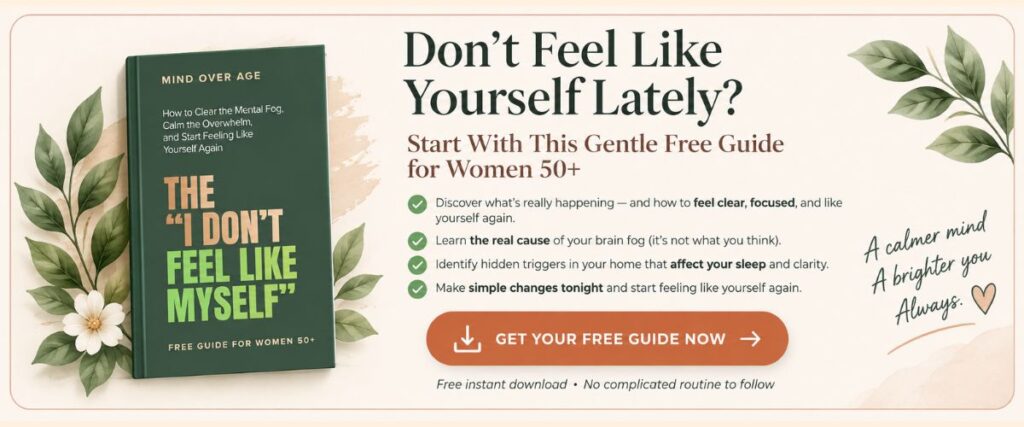
Feeling a Little Unlike Yourself Lately?
If brain fog, forgetfulness, or mental overload have been making everyday life feel different, I’ve created a free guide for women over 50.
It’s a gentle place to begin understanding what you may be experiencing, without pressure or complicated routines.
Frequently Asked Questions
Why do I forget what I just read?
Sometimes your attention moves away from the material while you’re reading. Distractions, mental overload, tiredness, and other factors can make comprehension and recall more difficult.
Is rereading the same paragraph helpful?
Rereading can help you understand something you missed, but familiarity doesn’t always mean you’ll remember it later. Briefly looking away and recalling the main idea may help with learning.
Does forgetting what I read mean I have a memory problem?
Not necessarily. Occasional difficulties can happen for many reasons. New, worsening, or persistent problems that interfere with daily life deserve professional assessment.
How can I remember more without making reading stressful?
Try starting with one simple question, recalling the main idea after a short section, and connecting new information to something familiar. Use whichever approach feels comfortable.
❖ Studies & Scientific Research Mentioned ❖
I believe in combining personal experience with scientific evidence. Here are some of the studies and articles that informed this video:
► The Relationship Between Mind Wandering and Reading Comprehension: A Meta-analysis (2022): https://pubmed.ncbi.nlm.nih.gov/35840838/
► 2. Why Does Working Memory Capacity Predict Variation in Reading Comprehension? (2012): https://pubmed.ncbi.nlm.nih.gov/21875246/
► Test-Enhanced Learning: Taking Memory Tests Improves Long-Term Retention (2006): https://journals.sagepub.com/doi/10.1111/j.1467-9280.2006.01693.x
► Improving Students’ Learning With Effective Learning Techniques (2013): https://www.psychologicalscience.org/journals/pspi/1529100612453266/?utm_source=chatgpt.com
Disclaimer: This article is for general educational purposes only and does not replace individualized medical advice, diagnosis, or treatment.